
Do you remember the “Why?” stage?
It usually starts when kids are three years old. “Why is the sky blue?” “Why do dogs bark?” “Why can’t I have ice cream for breakfast?” It is very tiring. It never stops. We parents sometimes wish we could hit the pause button.
And then, we hand them a tablet. And suddenly, we get our wish. The questions stop. The room goes quiet.
It seems like a win. But we need to ask ourselves an uncomfortable question: Did they stop asking questions because they are happy or because they are sedated?
In the digital age, we’re raising kids who are great at swiping for answers but not so great at asking questions.
This is where the Socratic Tablet method comes in. This framework is about changing the way we think about screen time. It is named after the philosopher Socrates, who was known for asking questions instead of giving answers. (Yes, it can be frustrating to not get any direct answers, but the whole point is for you to figure out the answer by yourself!)
It’s about going from “What does the screen show me?” to “What can I ask about this screen?”
What Is the “Socratic Tablet” Approach?
The digital world of today is meant to be “frictionless.” Algorithms can guess what your child will want to watch next even before the current video ends. Apps give you rewards for tapping, not for thinking.
The Socratic Tablet philosophy says that this lack of friction is actually bad for learning.
Learning really happens when there is a gap, like when you’re confused, curious, or have a problem to solve. Socrates didn’t give lectures; he pointed out flaws in people’s ideas. He got people to think.
The tablet is the teacher and the child is the vessel when the child uses it passively. When a kid uses a tablet Socratically, the child is the researcher, and the device is just a library.
The goal is not to get rid of the tablet. The goal is to switch from Passive Consumption to Active Inquiry.
The 3 Levels of Digital Interaction
We have levels of cognitive engagement with screens, just like we have food groups. Most kids (and let’s be honest, most adults as well) are stuck at Level 1.
Level 1: The Passive Swipe (The “Zombie” Mode)
What it looks like: The kid is slumped over. The videos start playing on their own. If you ask them, “What are you watching?” they might mumble or not hear you at all. The Brain State: This is like sleepwalking in the digital world. The brain is getting information, but it’s not doing anything with it. The problem is that the algorithm is in charge of the curiosity loop 100% of the time.
Level 2: The Reactive Tap (The “Lab Rat” Mode)
What it looks like: They are playing a game, but it’s repetitive. Tap the coin. Break the candy. Get over the problem.
The Brain State: It looks like it’s working, but it’s mostly reflex. It’s “Stimulus -> Response.” There is no questioning, no strategy, and no creativity. The truth is that they aren’t playing the game; the game is playing them.
Level 3: The Socratic Interaction (The “Inquirer” Mode)
What it looks like: The child stops the video to ask a question. They change apps to find out something. They use the screen to make things happen in real life. The Brain State: Very involved. They are sceptical, interested, and in charge. This is where critical thinking starts.
The “Attention Economy” Trap (Why Apps Hate Questions)
Why is Level 3 so hard to find? It’s not because your child is lazy. That’s because the apps are made to prevent it.
We should be honest about how the “free” apps and video sites our kids use make money. Their goal is not to teach your child. Their goal is to get your child’s attention.
Here is the cold economic truth:
- When your child pauses a video to ask “Why?”, the watch time stops.
- When your child closes an app to go build a Lego tower based on what they saw, the session ends.
- When your child thinks critically, they are less likely to click on an impulse ad.
The “Attention Economy” makes money when your kid is in a daze. Questions break the trance just like Max running away from Vecna’s mind prison (Stranger Things fans, (IYKYK!) So, these platforms are designed to be as smooth and full of answers as possible so that they can keep making money.
Understanding this empowers you. You aren’t just fighting “screentime”; you are fighting a billion-dollar industry designed to keep your child from asking questions.
How to Turn Passive Screen Time into Socratic Moments
You don’t need to be a philosopher to fix this. You just need to reintroduce “friction” (the good kind) into their digital diet.
Here are three practical strategies to turn the tablet back into a tool:
1. The “Pause and Predict” Game
Passive watching is easy because the brain doesn’t have to work. Change that.
- The Move: While they are watching a cartoon or a show, randomly hit pause.
- The Question: “What do you think will happen next?” or “Why did that character make that face?”
- The Result: You force the brain to wake up, analyze the context, and make a prediction. You turn a viewer into a storyteller.
2. The “Fact-Checker” Challenge
Kids tend to believe everything they see on screen. We need to teach them about healthy skepticism.
- The Move: If they are watching a video about dinosaurs or space, interrupt with curiosity.
- The Question: “Wait, is that true? Did T-Rex really sound like that? Let’s close this video and search for ‘T-Rex real sound’ on Google.”
- The Result: You teach them that the video is just one source, not the ultimate truth. You teach them to cross-reference.
3. The “Game Designer” Perspective
Children often see games as places that can’t be changed. We want to teach them that someone made the rules for how this world works and that they can have their own opinion about it.
- The Move: Wait for a moment when they are really into a game, or perhaps a bit frustrated by a specific level.
- The Question: “If you were the boss of this game, what is one thing you would change to make it better?”
- The Result: You instantly validate their opinion. They stop just “reacting” to the game and start “critiquing” the design. You’ll be surprised—they might say, “I’d make the levels shorter,” or “I’d change the colors.” That is the beginning of design thinking.
Age-Appropriate Socratic Guidelines
Toddlers (2–5 Years): You Are the Socrates
At this age, the screen should never be a babysitter.
- Strategy: Co-viewing is mandatory. You are the narrator. Point at the screen and ask, “Where is the red bird?” or “What sound does that make?”
- Goal: To connect the pixels on the screen to words and concepts in the real world.
Elementary (6–12 Years): The Guide on the Side
They are using screens independently, so your role shifts to “The Editor.”
- Strategy: Don’t just ask “Did you have fun?” Ask specific questions: “What was the hardest level you beat?” “Did you learn anything that surprised you?”
- Goal: To make them reflect on their consumption rather than just binging it.
Tweens & Teens (13+ Years): The Skeptic
They are deep in the algorithm now. Your job is to teach them to see the strings.
Strategy: Discuss the feed. “Why do you think the app showed you this video? Does it make you feel angry or happy? Why would they want you to feel that way?”
Goal: Digital literacy and emotional regulation.
Common Myths About Asking Questions
Myth #1: “Interrupting them ruins their focus.” Reality: There is a difference between “flow state” (creative focus) and “zone out” (passive consumption). Interrupting a zombie-mode session is not ruining focus; it’s waking up the brain.
Myth #2: “Google has all the answers, so they don’t need to ask.” Reality: Having access to information doesn’t mean you know it. The future skill isn’t knowing the answer; it’s knowing what question to ask to find the answer.
Myth #3: “Video games are just mindless tapping.” Reality: Some really are. But many open-world or strategy games are essentially giant math and logic puzzles. The difference lies in whether the child is playing deliberately or just reacting.
For a tired parent, a child who is quiet on a tablet can be a blessing. We understand. We’ve been there.
But let’s not mistake silence for satisfaction. Let’s not mistake swiping for skill.
Don’t feel bad the next time you see that glazed look in your child’s eyes. Just be curious. Take a seat next to them. Hit the pause button. And ask a question.
One question can break the spell of the attention economy and make a passive consumer into a curious child again.
So, here’s what you need to do next: Don’t ban the screen. Simply put a question mark at the end.


Related Posts
The ‘Tom Sawyer’ Effect: How to Trick Your Child into Loving Math
We often treat math like "medicine"—something unpleasant that must be…
Stop Worrying About “School Readiness”:The 3 Skills That Actually Predict Future Success
We obsess over whether our kids can recite the alphabet…
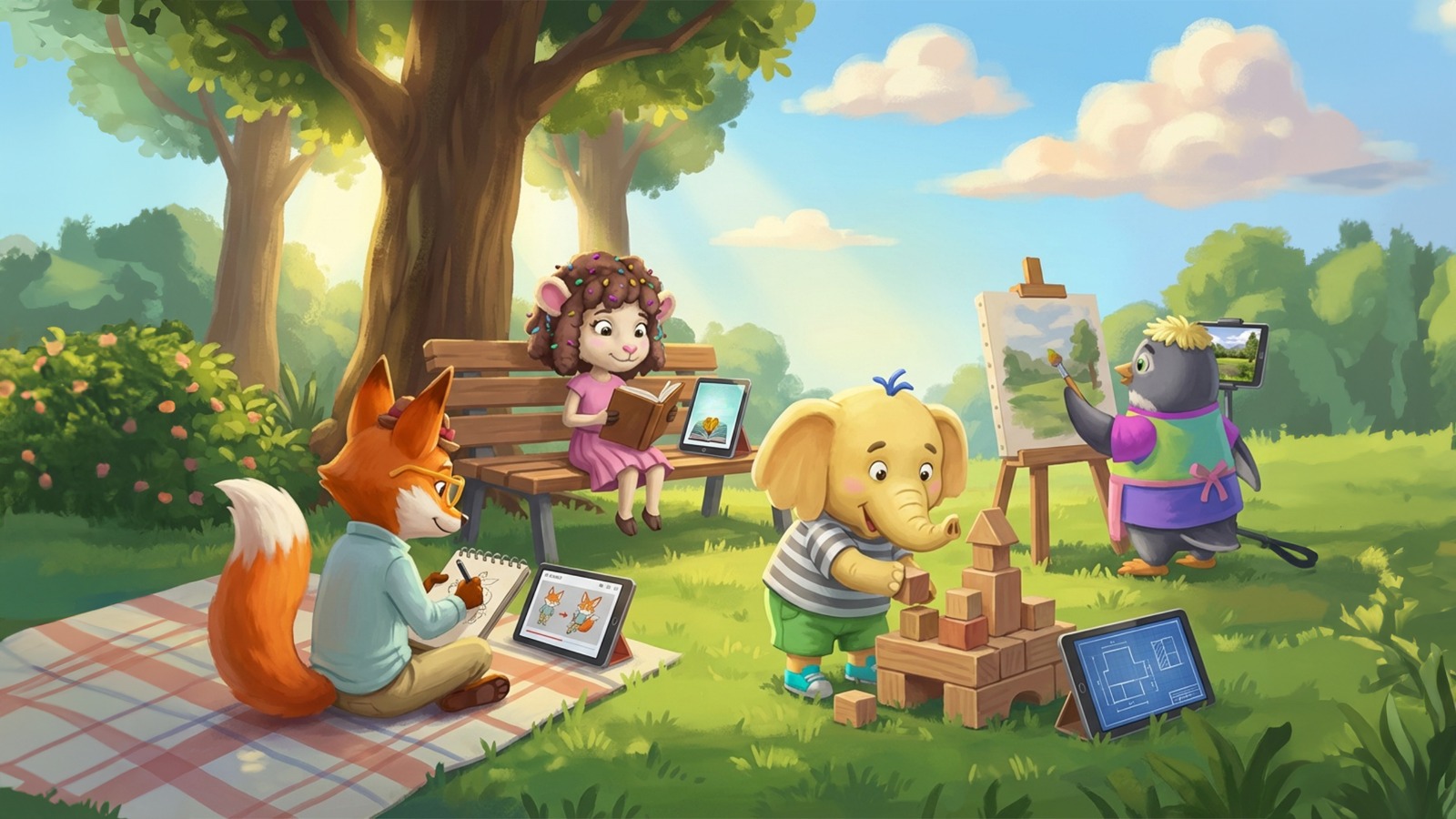
The Socratic Tablet: Why ‘Asking’ Matters More Than ‘Swiping’
In the digital age, we're raising kids who are great…

Screen Time Nutrition Analogy: Is Your Child Consuming ‘Empty Calorie’ Media?
Screen time nutrition analogy: Learn why not all screen time…